It Isn’t “Just the Weather”
Updated: Aug 8

I was reading The Guardian the other day, which is one of the best, if not the best, newspaper for climate change coverage. I say this, despite the fact that it still siloes the subject into a special section called “Climate Crisis and Environment.”
It also continues to publish front page headlines like “June Heatwave Kills about 2700 in
England and Wales, data says” with no reference to climate change, until you hit the body of
the story.
Which, quite frankly, is better than most newspapers do.
Indeed, in a recent issue of The Guardian, there’s an article about just that – the fact that an analysis of British newspapers revealed that 72% of articles covering the UK’s June heatwave
failed to even mention the climate crisis.
So why is that significant?
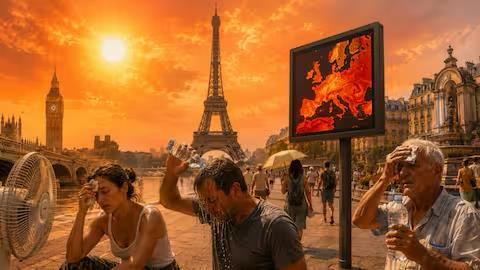
Well, if we don’t frame a 36 to 40 degree C. heatwave as a climate-driven event, it quickly
becomes just another weather anomaly. An anomaly which then becomes the new baseline for what we deem to be “normal” weather.
But there’s nothing normal about it. In fact, for Winnipeggers, the recent 36 degree C heatwave isn’t just one or two degrees above the norm. It’s a staggering ten degrees above the average July temperatures measured over decades. While last year’s May temperature of 36.4 C blew the average temperatures for that month out of the water.
So, what these heatwaves really represent is a manifestation of a CO2 packed atmosphere
that’s radically altering and warming the global climate, largely thanks to the burning of fossil
fuels.
And nothing has prepared our city to deal with that. In fact, city council and the mayor have
failed miserably in efforts to even come close to their 2030 emission reduction target of a mere 20%, given that a recent city report indicates that emissions from land fill, city buildings, vehicles and other sources once again went up, this time by 1.5%.
The biggest culprit is the Brady landfill which still receives mountains of organic waste. That
buried waste then decomposes releasing not just CO2 but methane, a particularly nasty greenhouse gas. Despite that, council has delayed funding the curb-side pick-up and composting of organic waste, until – you guessed it - 2030.
This, when hundreds of other Canadian municipalities have had those programs in place for as much as a decade.
Nor has the city taken decisive action to adjust infrastructure spending in a way that might help us adapt to, or at very least mitigate, the impact of extreme weather. Just take the recent decision to delay providing Parks with the budget needed to acquire another 1000 acres of heat busting, water absorbing greenspace.
Meanwhile cooling trees and forests continue to fall to construction; cooling centers are thin on the ground and landlords take no responsibility for ensuring their buildings are habitable during +30 C heatwaves.
Worse still, we don’t even bother to count the number of Winnipeggers who die as a result of high temperatures. In fact, heat related deaths aren’t even recorded in this province, despite the fact that extreme heat is a recognized public health issue. Instead, officials can only gauge the number of people dying by “excess mortality counts.”
In other words, a sudden jump in the number of deaths during a heat wave.
And that simply isn’t good enough.
Even more telling, when the Free Press questioned mayoral candidates about how the city might better protect its citizens during heatwaves, the only candidate who didn’t appear to have an opinion was our current mayor.
He only answered the question when asked again a day or so later, by defending his record of installing seven water stations across the city and touting what he calls 24/7 cooling centers, which total four, most of which do double duty as homeless shelters.
He then went on to observe that he would consider “exploring” a call to set maximum
temperatures for rental units.
To which I would respond – “What’s to explore? Just do it.”

So, here’s the thing – ad hoc, add-ons like a couple of water fountains or temporary cooling
tents or compost drop off stations don’t represent a plan. What this city needs to do is enforce and fund its own Community Energy Reduction Roadmap (CEIR) and assign capital to a comprehensive climate adaptation strategy, which would include a budget for the purchase of additional greenspace.
Because, if council doesn’t act now, our friends and neighbours will continue to die in the heat or watch helplessly as their homes drown in flood waters or burn to the ground.
So think about that when you read an article about a record-breaking heat wave or flood that
doesn’t mention climate change. And, most importantly, think about it when you head to the
polls in the next civic election.


Comments