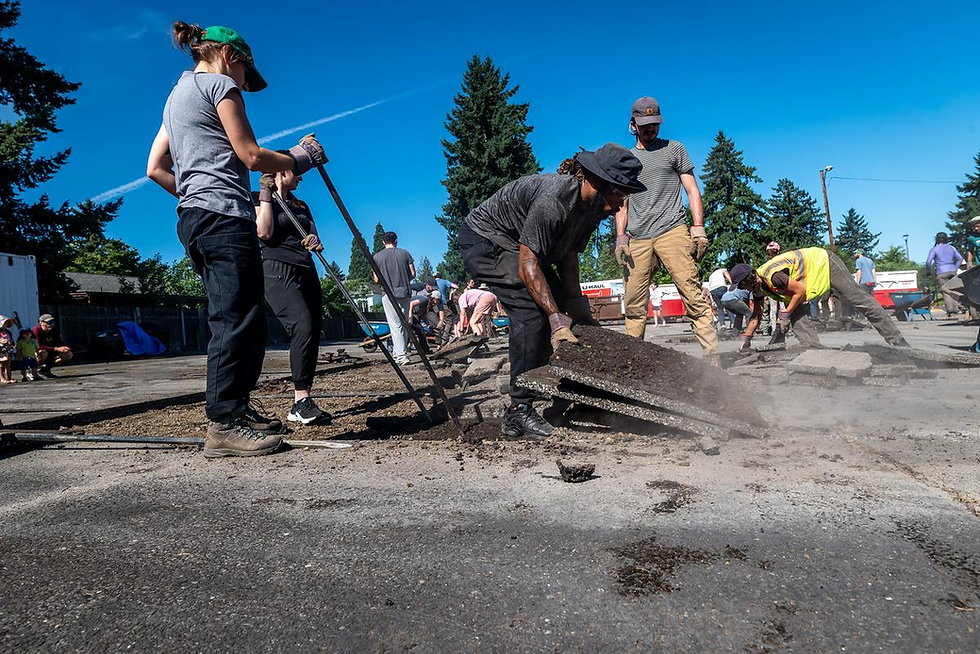
Depave Paradise, Dig Up A Parking Lot
Updated: Jul 20
We use it to build everything from skyscrapers and shopping malls to plazas and highways,
and currently, some 70% of the world’s population lives in structures built from it. Today it ranks as number two on the list of the world’s most consumed substances, second only to
water.
It’s that ubiquitous “wonder” material called concrete, celebrated by architects and city
planners everywhere because it’s cheap, strong and so malleable it’s capable of taking
almost any shape. Better still, it’s fire resistant and incredibly easy to use.
With a couple of bags of cement, some sand and water, a single person can
build themselves a concrete shelter in just a matter of days.
But like all purported wonder materials – from polymers to plastics –concrete can be
hugely destructive when used in vast quantities,.
And the fact that the world produces a staggering 33 billion tons of it every year is nothing short of devastating. The dust generated from mining materials like limestone can be lethal and cement production sucks up a 10th of the world’s industrial water.
Worse still, harvesting of one of concrete’s essential ingredients – sand – can be
staggeringly destructive, altering river courses and destroying many of the world’s beaches.
But it’s the impact of concrete on both the atmosphere and the world’s cities that may be of
greatest concern for the future. As one writer observed: “If concrete were a country it would
be one of the world’s largest producers of atmospheric CO2, ranking third after the United
States and China.”
If that wasn’t bad enough, high levels of atmospheric carbon dioxide also make reinforced concrete more vulnerable. That’s because concrete also absorbs carbon dioxide which, ironically, can cause its encased steel rods to rust more quickly, shortening the material’s life span.
Which brings me to my next point – we may see concrete as permanent, but it’s not. In fact
the lifespan of reinforced concrete is estimated to be between 50 and 100 years, and when
used in road construction, it’s even less durable, lasting as little as 30 years. Worse still, it’s
almost impossible to recycle, which creates vast islands of concrete landfill.
But it’s the impact of concrete on the places where most of us live that may pose the
greatest threat, because as much as 80% of urban space is now made up of heat
absorbing, water repellant concrete based roads, structures and parking lots.
And as extreme weather accelerates, bringing with it ever more intense heatwaves and
superstorms, cities layered in concrete will become increasingly vulnerable to rising
temperatures and flooding.
So what, exactly, are we to do?
Well, we definitely shouldn’t throw the baby out with the bathwater, because despite its
serious downside, concrete is an incredibly useful material.
What we need to do is use a lot less of it and dig up or “depave” as many of our city’s paved
surfaces as is reasonably possible. Then we need to replace them with the kind of
infrastructure that offers us maximum protection from extreme weather.
I’m speaking, of course, of natural or green infrastructure – city forests, grasslands and
wetlands which we’ve consistently dug up or mowed down to make way for an ocean of
concrete and asphalt.

In fact there’s actually a global movement aimed at depaving the urban landscape. Once a
largely grassroots undertaking, a number of cities from London, UK and Hamilton, Ontario to
Paris and Leuven, Belgium are making serious efforts to depave their municipalities, by
targeting areas where concrete isn’t essential - from front yards and public squares to
traffic roundabouts and parking lots.
Those areas are then replaced with soil and planted with the shade trees , bioswales and
gardens that help to make their cities spongier, greener and more climate resilient.
Those actions don’t just benefit humans. They offer other urban creatures, from pollinators
to birds, a safe and bountiful refuge.

Leuvens even has something called the “tile taxi” which picks up the concrete tiles
homeowners remove from their yards.
And the Netherlands has gone one step further by implementing an eco-tax, charging homeowners and developers 250 euros ($400 CA) per square meter if the concrete surfaces around their buildings exceed 40%.
So if your yard is layered in concrete, think about getting rid of it. Ditto for your child’s
schoolyard – I mean, what kid wouldn’t prefer trees and food gardens over concrete and
asphalt?
And if the city administration balks at the idea of depaving a schoolyard or breaking up
concrete to provide your neighbourhood with more trees and gardens, call your councillor
and tell them to get those policies changed.
Because if we don’t demand change, we may all be in serious trouble as extreme, climate-
driven weather escalates.


Comments